Wet-bulb temperature is a fundamental psychrometric property that defines the theoretical lower limit of cooling achievable through water evaporation. Understanding this value is essential for assessing the performance of evaporative cooling systems and determining the efficiency of natural cooling processes.
What Is Wet-Bulb Temperature?
Wet-bulb temperature (WBT) is the temperature read by a thermometer covered with a water-soaked wick over which air is passed . It represents the temperature a parcel of air would reach if cooled to saturation (100% relative humidity) solely through the evaporation of water into it, with the latent heat supplied by the air parcel itself . At 100% relative humidity, the wet-bulb temperature equals the dry-bulb (ambient) temperature; at lower humidity levels, the wet-bulb temperature is always lower because evaporation occurs more readily in drier air .
Relation to Evaporative Cooling Efficiency
The wet-bulb temperature establishes the physical boundary for evaporative cooling. Direct evaporative cooling works by drawing outside air through a water-saturated medium, causing water to evaporate and absorb heat from the air, thereby lowering its dry-bulb temperature . The lowest temperature achievable through this process is the incoming air’s wet-bulb temperature—no evaporative cooler can cool air below this threshold under a given set of ambient conditions . Consequently, the difference between the dry-bulb and wet-bulb temperatures (the wet-bulb depression) indicates the cooling potential: a larger depression means greater evaporative cooling capacity, while a smaller depression signals limited effectiveness and higher achievable temperatures.
Calculating Wet-Bulb Temperature
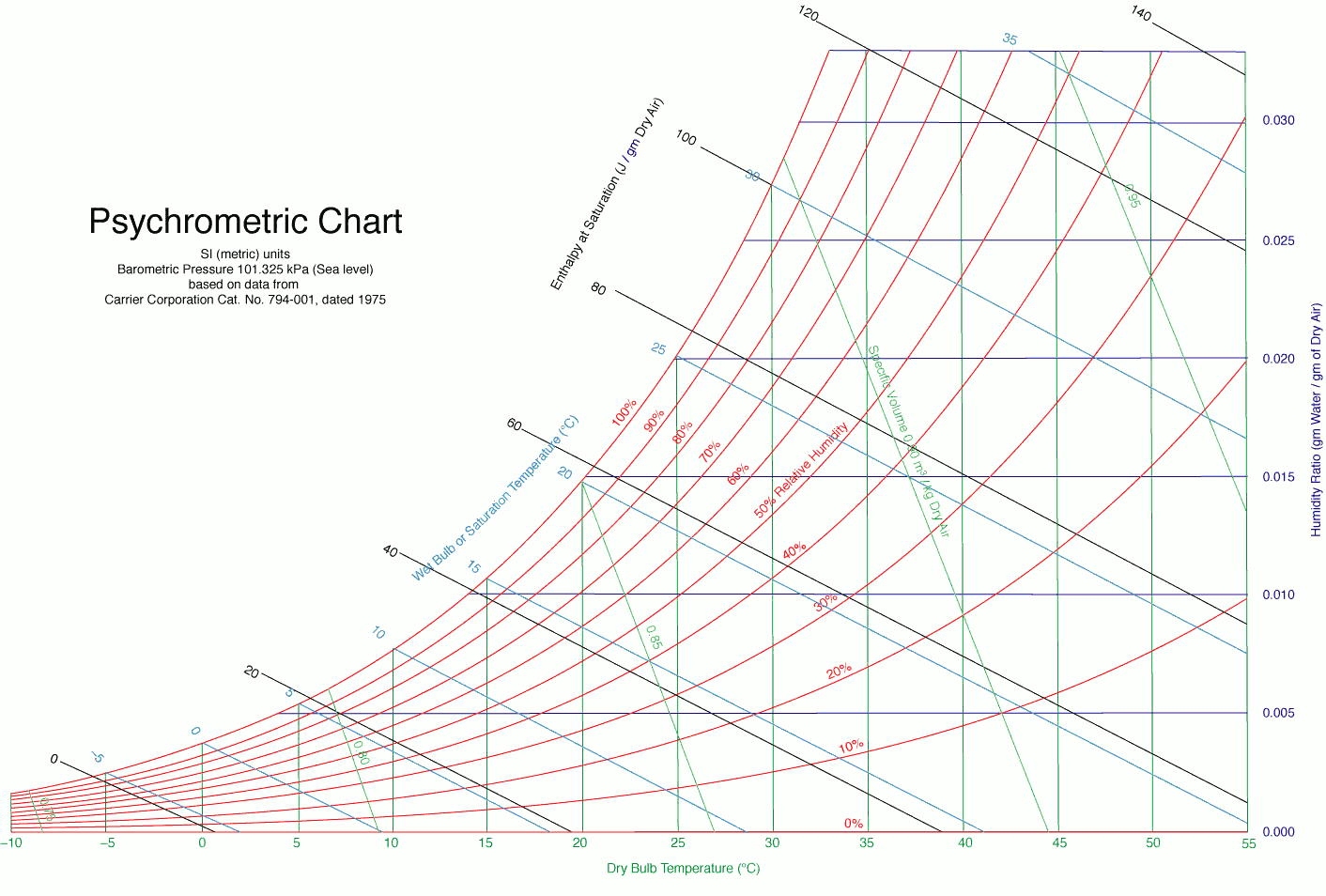
Wet-bulb temperature can be determined through graphical or computational methods. The traditional approach uses a psychrometric chart, where the wet-bulb temperature is found by locating the intersection of the dry-bulb temperature and humidity ratio lines, then following the constant wet-bulb line to the saturation curve . For a more convenient alternative, an online wet-bulb calculator requires only the dry-bulb temperature and relative humidity as inputs to deliver an immediate result, eliminating the need for manual chart reading.